Oct 14, 2015

Fun Little Surprise...

I frequent a number of different hunting forums throughout the year and more than just a few times does a discussion about “which bullets are best” erupt. As expected, responses are filled with personal opinion and stories of how bullets either failed miserably in the eyes of the hunter or are the best thing since sliced bread. I stand somewhere in between and through my research and readings I have come to find that each bullet on the market serves a purpose and is designed to function within certain parameters based upon its design.
It is always a special treat then, when processing a game animal to find a bullet within the body of the animal and be able to inspect the terminal performance of the bullet used and evaluate it based upon the shot taken and the path through the animal’s body. This year I uncovered such a treasure while butchering the cow elk that my friend had shot with his muzzleloader.
The load was a .45 caliber 250gr Hornady XTP.MAG over three pellets of Triple 7 powder. By all estimates his was achieving velocities in the neighborhood of 2000 feet per second (fps). The Hornady XTP-MAG is a fairly rugged jacketed hollow-point bullet designed to function optimally at velocities between 1200 and 2000fps. The jacket is scored slightly to facilitate the jacket peeling back in a uniform manner.
The bullet was located deep within the opposite hind quarter of the cow elk. It does not appear have hit any hard structure or bone. The mushrooming of the bullet is excellent, expanding to more than twice the original diameter. I cleaned and weighed the bullet to get a feel for how well the bullet retained its original weight. The bullet weighed 221gr so that ends up being 89% weight retention. For a lead core bullet that is really high and can probably be attributed to the bullet not hitting any bone or other hard tissue.
The most interesting thing to me was looking at the base of the bullet. The copper jacket peeled back in perfect uniform petals and actually folded back at the base of the bullet in a neat overlapping pattern.
I would say that the performance of this bullet on this particular shot was absolutely textbook and is the kind of stuff that bullet manufacturers put up on their websites

Sep 28, 2015

Opening Day Double!

My 2015 hunting season had already opened on September 10th because I drew a pair of doe pronghorn tags in Wyoming but I hadn’t been able to make the time to drive out there before the Utah general muzzleloader deer hunt started.
The Friday before the deer hunt opener I was finally able to make it out to the range and found that over the course of the year nothing had changed. My groupings were what I had come to expect from the previous couple years, so I didn’t waste any components or money by taking more shots than what was necessary to see what I needed to see.
Darren and I went and bought groceries late Monday night, and I prepared my gear. Cody was set to fly in to Salt Lake International Airport at about 7:00pm Tuesday evening from Albuquerque, so the plan was for me to pick him up at his parent’s house once I had helped get all my little kids to bed for the night. We would than make the short drive up the canyon to my family cabin where my grandfather, father, and brother (with his two young sons) would be waiting for us. I had shared a couple of ideas for different hikes Cody and I could take on opening day and Cody said that he wanted to stay out the whole day. So we decided on a route that would take us far from the parking spot where we would leave the ATVs, hoping that we would be so far from the ATVs that going back to the cabin for lunch would not be a desirable option.
We decided to leave the cabin Wednesday morning and time the drive so that we would arrive at the gate right at legal shooting light. Our timing was perfect as we rode through the pre-dawn and began to enter the large meadow and approach the gate. We stopped to inspect a number of does at the side of the road to our right, then I glanced to my left and on the skyline not far from me I see a head with respectable antlers between the ears. I jumped off the ATV, ripped my right glove off with my teeth, and tried to get a primer in one fell swoop. It wasn’t as smooth as I had hoped or envisioned but eventually I took a bead on him at about 50 yards and tried to squeeze the trigger but nothing happened. There’s a little thing on a gun called a safety… and in this case it functioned exactly as intended sparing this buck momentarily. One quick flick of the finger and the quiet of the early morning was broken.

A short tracking job later I found my buck piled up on a log in the middle of the game trail. He is a beautiful little 3x4 and my best buck to date.
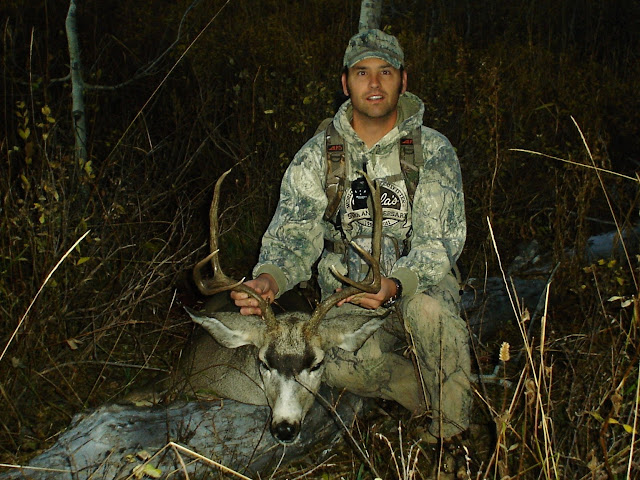
The drag was short back to the ATVs and we were on our way back to the cabin to hang him in the basement in short order. Since we had planned to be out all day, hiking into relatively unknown areas to us we decided to take the morning and get my buck skinned, quartered, and boned out before heading into one of my favorite little bowls in the afternoon. By late morning we had the buck processed and I had saved the cape for my grandfather who had wanted to mount some old antlers from “Utah’s Glory Days” but lacked a good looking cape. We cooked us up some late breakfast and prepared to head out once again.

Shortly after lunchtime we were back out on the ATVs again. We made the several miles drive through mud puddles and up rocky slopes to the little parking area where the private property ends and public land begins. From there it was a mile and a half hike down into the bowl where we would sit in the shade of a large pine tree. We hadn’t even arrived at our spot under the pine tree when I spotted 2 spike elk grazing through the understory of some aspens 250 yards up the hill from us. Not long after that 4 cows worked their way along the edge of the pines and through the same aspens. It was early and it was hot so we knew at some point in the evening that they would come down to the pond directly in front of us for water, but for the time being the elk were content to mill around in the shade of the aspens and pines of this north facing slope.

Sometime around 3 or 3:30 some movement caught my eye coming from the bottom of the canyon towards us… a coyote. The coyote ran right up the bottom of the bowl right past the pond then up the hill almost directly into the elk. That kind of set everything into a bit of chaos. The elk barked and carried on for quite a while but eventually settled down, the problem was the coyote had ran between the elk and the pond so every time the cows started to come down to the water they got agitated again.
A bugle rang out from the pines and I was hoping to get a glimpse of this herd bull. He bugled several more times and sounded like he was getting close. Up in those same aspens where we originally spotted the pair of spikes I was able to get my first look at him. It wasn’t a great look but I could tell he was by far the biggest bull of the group and was very respectable. He ran around almost in a bit of a panic, kind of jumping around and darting back and forth through the trees for several minutes, then disappeared into the pines again. We had figured that since the coyote had been through the area that there was a very real possibility that would not get a chance to fill our antlerless tags tonight. So I decided to take matters into my own hands, got one of my mouth calls out of my pack, and blew two soft cow calls from where we sat. That turned the mountain to life. Within a couple seconds the herd bull emerged from the pines and stood still as a statue in the small clearing looking my direction and I finally got a really good look at him and what a stud of a bull. His left side was a perfectly formed 6 point antler, probably of 310 to 320 caliber if the right side was a match… however the right side was not a match. From the right side of this bull’s head grew a single curving spear of an antler that had to be 3.5 to 4 feet long. I was so interested with just looking him over and admiring the uniqueness of his headgear that the thought to take any pictures of him didn’t enter my mind until it was too late.
Then my attention turned back to the group of 4 cows who were now up and moving, being pushed by two smaller bulls, a 2x2 that appeared to have unusually thick antlers compared to other young 2x2s that I had seen before and a bizarre little 2x4 bull who’s left side looks more like a caribou antler. Two of the cows had made their way down to where they were just starting to get in range for a shot but it was clear that the discomfort from the coyote was gone and they would be coming all the way down to the pond. Cody was the first shooter in this scenario because he would only have the deer hunt to fill his antlerless control tag while I would have several other opportunities to fill my cow tag. Cody got set up on the shooting sticks and we waited. The first cow made her way down the trail leading to the pond. The first gap in the pines that she would pass through was about 150 yards. I told Cody to wait and be patient. The second gap that she would pass through in the pines was 115 yards, but again I told Cody to wait and be patient. Finally, as the cow cleared the last of the pine trees and stepped into the clearing around the water hole I told him to take the first good shot. She stopped and stood broadside at 85 yards and Cody’s gun went off and down she went. It was about 5:30 so we hustled over to her and began the quartering and boning process knowing that it was a race against darkness now. We also decided that we didn’t want to make two trips down into the bowl that night so we would haul her out in one heavy load each. We reached the top of the bowl right as the last little bit of light faded and fired up the ATVs to head back to the cabin. At this point we realized/remembered that the headlights on one of the ATVs didn’t work so we slowly made our way along the trail with Cody using his headlanp as his headlights which made for a couple of very interesting sections of the trail back to the cabin. We watched those elk for about 4 hours before a shot was ever taken and sitting back watching that little herd for that span of time was pretty cool.

Thursday we tried a couple of things to fill Cody’s deer tag and my elk tag. We rode around in the morning just to give our bodies a little extra time to recover from the haul out the night before. We saw a lot of deer but didn’t shoot anything. In the afternoon we decided to go do some more hiking around and ended up getting separated. Ultimately I went south and he went west and we didn’t meet up again until dark when we returned to the ATVs. I saw a half dozen bucks with two of them being pretty nice but I was looking for elk and didn’t find any.

Friday afternoon we went back in to the ponds and sat in the same spot as Wednesday afternoon and evening. We knew it was a long shot because we would quite literally be sitting over the carcass of the cow that we left two nights before. A bull and cow moose were up the hill making all sorts of noise but eventually the caribou bull showed up and came all the way down to water. He was the only elk to show up that night and we made our way up out of the bowl and back to the ATVs before dark so that we didn’t have to drive out again using a headlamp in place of the broken headlights.

Saturday morning we decided to try the canyon right above the cabin and spend the morning there. We hiked to a small knoll and had a seat. We could hear animals in the canyon but it was so thick that we couldn’t see anything. I thought I’d get out my calls again and give it a try because the critters in there were definitely not deer & had to be moose or elk. I cut loose a couple quick cow mews and immediately something was headed my direction. After about 20 minutes I spotted a spike elk looking straight at me from some bright red oak brush about 150 yards away. He continued in my direction and eventually popped out of the brush at about 35 yards. It was a faceoff and he just stared at me wondering where this cow was that should be right there. More movement was heard from behind and within a matter of seconds a herd of a dozen elk… a raghorn 5x5, two spikes, and nine cows… ran over the knoll from behind me and within feet of my location. I was getting hit by the dirt and rocks they were kicking up and they ran past me. I was taken by surprise so badly that I didn’t even grab for my gun. The spike stayed put however, and as this herd crashed through the canyon in front of me the spike stared at me for another couple seconds before joining the stampede. I had never been successful (at least to my knowledge) in calling a bull into my location like that. It was really cool.
The last few years have taught me one thing… I enjoy hunting deer but I am an elk hunter! I love chasing those critters and any time that I can be in the woods with them I am happy. I have two bulls on my “hit list” for the general muzzleloader hunt coming up the end of October… I can only imagine how phenomenal that 6x1 bull would look as a European mount on my wall! But I’d not hesitate to shoot that caribou bull just because he is unique as well and I have several pictures of him from trail cameras over the summer so I feel like there’s some history there between us.

Sep 9, 2015

Last Trail Cam Check for the Summer

Spent Labor Day weekend with my family up at the family cabin and was able to sneak away briefly a couple times to check my trail cameras. I have had a couple of occasions with the cameras getting broken into when hunts are open, so I made it a point this year to bring the cameras down off the mountain for the remainder of the archery and the entirety of the muzzleloader and rifle hunts. I will be hunting both muzzleloader deer and elk in this area and I am planning on taking the cameras and putting them back up during the muzzleloader elk since that is the last general hunt of the year and letting the cameras go for as long as the batteries will last through the winter.
I'm a bit frustrated that I again only had two of the four cameras function even though I had confirmed that all four were properly functioning when I left them last. I'll open them all up and make sure they are working right before I put them back out again.
The first set of cameras I checked are over a couple of small seeps (we call the “Bog Holes”) a quick 15 minute hike directly up the hill behind the cabin. On the hike in I reached a small clearing and looked uphill to see a pair of ears peeking just above the brush looking at me from about 80 yards away. The wind was in my favor and the small doe knew I was there but didn’t know where so I figured I‘d take a chance and see how close I could get to her. I got to 40 yards through a wide open clearing before she bounded off down into the draw. I watched for her to come up the opposite side to see if she was alone… and she wasn’t. A nice little buck was leading her through a clearing on the opposite of the draw on a very well used trail. He was a pretty good buck from what I could see, but I didn’t have my binoculars to closely inspect him nor did I have my good camera with me so I was fumbling with my phone to try and get a picture and wasn’t able to get anything even worth looking at a second time. I quickly reached the cameras and took them down. On the way back to the cabin I could hear the little kids playing (seven small children between the ages of 10 and 4) and running around “exploring” the mountainside below me. When I got close enough to the cabin to see them I went into stealth mode and got to within about 20 yards of the group. I leapt into action roaring loudly and running down a game trail at them. They screamed and scattered while the adults sitting on the back porch saw the whole thing play out in front of them. My wife and my grandmother both laughed to tears, while my 5 year old nephew retreated inside the cabin to have a good cry because, as my brother put it… “he doesn’t do scared very well.” I wish one of the adults that saw the whole thing play out would have videoed it.
I checked the second set of cameras a couple days later and quickly make my way into the bowl where they had been placed. It was a quick and uneventful hike and I was able to make the trip in about an hour.
I went through the pictures with my grandpa watching over my shoulder the whole time. Here are some of the highlights but I’ve added all the pictures HERE:


Now that the seasons are upon us remember to follow me on Twitter!

Aug 8, 2015

The First Trail Cam Check of the Summer

I broke away from work early on Friday afternoon, picked up a buddy at the UTA Park n Ride lot, and we headed up the canyon. The plan was to quickly check the four trail cameras that I had placed in late June then hopefully boogie up to the spot where we like to glass from. We were hoping that we would be able to get some good glassing in before the rain started.

The hike to the first set of cameras went quickly enough. The first camera that I checked (this is the one I call Camera #3) had 500+ pictures on it. I pulled my laptop out of my pack and quickly copied all those pictures over, cleared the memory card, put the card back in the camera and checked the battery status. The camera still said 40% power, so I figured I'd "let it ride" on that set of batteries. The second camera had malfunctioned and not taken any pictures. Unfortunately, this happens to me at least once every year. I re-formatted the memory card just to make sure it wasn't the card, checked the batteries (40%... so we'll "let it ride"), and set the camera again. I made sure it was taking pictures before I left it. It was slightly later than I had hoped so we hurried as fast as we could out of that area, the hike was mostly downhill so it went quickly. My grandmother timed us from the time we left until the time we got back and she clocked us at 35 minutes.

The hike in to the second set of cameras is slightly longer, more uphill elevation, but gratefully it also went quickly enough. My friend was running out of gas since he had been doing some serious physical labor all day while I sat at my desk in front of a computer screen, so I left him about halfway up the first incline and quickly checked these cameras on my own. I bumped several deer on my way to the cameras, all does and fawns. The first camera (this is the one I call Camera #1) also had 500+ pictures on it. I quickly transferred the pictures to my laptop, replaced the card, and checked the batteries. The second camera in this series had a malfunction as well and over the course of about 6 weeks it only took 3 pictures... one of which contained a lone deer butt. If I was a baseball player I'd be a Hall of Famer batting .500, but I was a little discouraged that half of my cameras had not functioned properly.

I hustled down back to the car from checking these two cameras and we were able to drive all the way up on top to the spot where I like to glass across a large canyon and we immediately began spotting game. Dark clouds were beginning to gather and roll in, off in the distance we could see flashes of lightening and hear distant thunder. It was ominous, we knew we didn't have much time at our fingertips. We had already seen deer and moose, so the primary goal of this glassing session would be to spot some elk. Not five minutes in, there she was... a lone cow fed into a clearing just below a large pine tree and stood broadside. She was way over in an area that holds a handful of ponds and one of my favorite places to hike in to on the muzzleloader deer hunt. We watched as a small herd of about a dozen elk followed single file behind her. Not long after they trailed off into the trees our visibility was completely gone. Within a couple seconds, we were getting drenched so we quickly threw our gear in the car and headed back to the cabin.

Back at the cabin, with my grandparents watching over my shoulder, we looked at the pictures and saw a good mixture of deer, moose, and elk. One camera picked up some elk where we hadn't seen any elk before and had a serious amount of moose. I'm not seeing anything that is outrageously huge... but this is a general season deer and an OTC any bull area so I'm thrilled with what I do have. Here are a handful of my favorites:

Camera #1:


Camera #3:

Check of the rest of this batch of trail camera pictures... HERE.

Aug 4, 2015

Some Spreadsheet Changes!

Not only have I updated the Limited Entry (LE) and Once-in-a-Lifetime (OIAL) spreadsheet... but I have now linked over the completely updated and re-vamped Antlerless spreadsheet.

A quick word about a couple columns that I added last year that have been the most enlightening additions to the spreadsheet in a very long time. These two columns are "Years to Draw (MIN)" and "Years to Draw (MAX)." The Years to Draw (MIN) column shows the user how many years it will take for the user to reach what many call the max point pool assuming the applicant pool remains consistent. In other words how many years it will take for the user to reach a number of bonus points where he/she would be in consideration for a bonus tag. This is done by summing the number of applicants with more bonus points than the user and then dividing that number by the number of bonus tags. The Years to Draw (MAX) column shows the user how many years it will take for the user to be awarded a bonus tag if he is the absolute last person to be awarded the tag in that bonus point pool. This is done by performing the identical calculation as the Years to Draw (MIN) except in this calculation all the individuals with the same number of bonus points as the user are included.
So let's do a real world example just to make sure we all understand the concept behind these two new columns. Let's assume that I have 18 bonus points for LE elk and would like to draw a highly coveted Fillmore, Pahvant early any weapon tag. If I looked at the Projected Bonus Points for 2016 column I would assume that I could draw that tag within the next 4 years based upon the projection... however looking at the Years to Draw columns we see something VERY different! Based upon the 2015 applicant pool, the Years to Draw (MIN) column tells me that it will take me 16 year of applying just to reach the "max point pool" for this unit and be in consideration for a bonus permit. The Years to Draw (MAX) column tells me it could take as long as 23 years to be awarded a bonus permit assuming that I was the absolute last applicant in my bonus point pool to be awarded a bonus tag. In other words, there are enough applicants with 18 points that it could take 7 years for all the applicants with the same number of points or more to be awarded a bonus permit. Reality is that the applicant pool is ever changing as people change their applications from year to year, so a reasonable expectation to draw any given tag can be identified using these Years to Draw columns.
You'll notice that the Years to Draw columns as I have the formulas entered can actually go as low as negative one (-1). Any negative result in either of these columns should be interpreted as, "I would have drawn last year."

I received some feedback last year from an individual that thought that the calculation for the percentage should show 100% if the number of bonus points the user enters into the spreadsheet was greater than the projected number of bonus points. I'm not overly comfortable in linking a 100% odds based off a projection. I also don't like claiming 100% odds for anything relating to bonus points in the LE and OIAL drawings because I cannot foresee the variations within the applicant pool for the next year, so I elected to go with 99.9%. This should be interpreted as "virtually 100%." Another change made was to link the 99.9% odds to the column for "Years to Draw (Max)" instead of the bonus point projection. The calculation now will return a 99.9% result when the Years to Draw (Max) reaches zero. I feel much more comfortable with this interpretation of virtual guarantee of success in drawing a tag compared to basing the calculation off the projection for bonus points.

Another major change is regards to the calculations used in determining the odds for the preference points draws (e.g. general buck deer, antlerless deer, antlerless elk, and antlerless pronghorn). The previous calculations used a very similar formula as the bonus point calculations and was inherently wrong. I have updated the calculations for preference points to reflect how the preference point drawing is carried out. The calculation considers ONLY YOUR FIRST CHOICE... the DWR does not provide data on second, third, fourth, and fifth choices.

I am pleased with each of these changes, this spreadsheet is a living and breathing thing for me and it has evolved into something drastically different (and much more complex) than the very first spreadsheet that I compiled several years ago. As I continue to learn more about the process and exactly how the different drawings are carried out I am able to further refine and tune the calculations to provide the most accurate estimates for future success for those who find these spreadsheets useful. I welcome any feedback through the email links here on the right or via Twitter.

Popular Posts